Sunday, 28 March 2010

Tracing the unseen border...


While preparing for my forthcoming exhibition I was reminded of this project from 2008 by Manu Luksch at Ambient TV. The first phase of the project involved mapping the cameras around Whitehall between Charing Cross and Parliament Square. Unsurprisingly in such a sensitive area of the city her activity did not go unnoticed by the authorities. However, resolving to "act less suspiciously", she returned on the second day to map the range of one of the cameras she had identified on the first.

Previous posts on the development of my current project and street photography should indicate my ongoing pre-occupation with the kinds of invisible borders we unwittingly cross everyday. Without hindrance or warning we pass from public streets to equally open, and often unassuming private estates, unaware that certain of our supposed rights, however trivial, may be compromised. Then there are the secret and shifting demarcations of those S44 areas that remain exempt from disclosure under the Freedom of Information Act: unverifiable zones of exception, where the simple act of taking a photograph can render someone suspect.

What I like about Luksch's project is that she stuck around. Having traced the unseen border she set up her own border control. But far from limiting the passer-by, by standing sentinel at that invisible border she gave them back the choice and responsibility for themselves that they'd been denied.

Monday, 1 March 2010

London Festival of Architecture Exhibition Proposal

Those of you familiar with Urban Orienteer should be aware of my current collaboration with Mark at Dancing Eye. Recently we have teamed up with two more photographers and an architect, and submitted the following proposal for an exhibition to coincide with the London Festival of Architecture 2010. Further details to follow shortly.

Please read on...

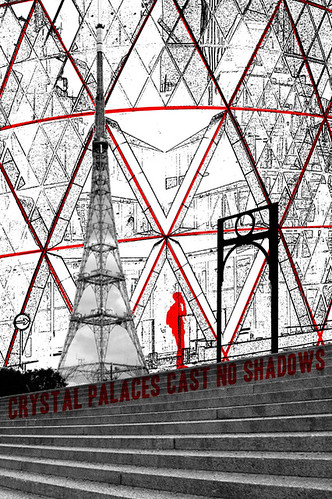
Intended as a reflection on, and engagement with, contemporary discourse in Architecture and Urban Design, this group show will coincide with the London Festival of Architecture 2010. Collectively our work seeks to provoke debate and to stimulate ideas amongst those interested in urbanism and the city. The material shown here comes from bodies of work that are continuing to develop, with In The Shadows of the Crystal Palace being a collaborative project in its own right.

We are currently in discussion with several other artists, writers, and film makers whose work we believe may complement our own. If you would be interested in collaborating with us, on either this or any other projects in the future, please do not hesitate to contact us (details below).

- In The Shadows Of The Crystal Palace -

In The Shadows Of The Crystal Palace is a collaborative work in progress by Mark Oliver (Dancing Eye) and Oliver Dawkins (Urban Orienteer). The project emerged out of their research into the tensions between public and private space, and the ways that urban planning and contemporary security strategies affect the shifting territories of these spaces.

Adopting an ambivalent approach to Joseph Paxton’s Crystal Palace as an architectural ideal, questions are raised on the themes of democratic transparency and territorial expansion.

In developing these lines of thought, examples are drawn from the increased inclination toward the large scale use of glass in new London architectural projects such as 30 St Mary Axe (the Gherkin) opened in 2004, Broadgate Tower completed in 2009, and both Bishopsgate Tower (the Pinnacle) and the Shard of Glass which are to be completed in 2012. Each finds its precursor in Paxton’s Crystal Palace which was first erected in London’s Hyde Park to house the Great Exhibition of 1851.

Recently the German philosopher Peter Sloterdijk has argued that this building can be considered paradigmatic of the project of European modernity as a whole. This, he suggests, is premised on the creation of a controlled environment which attempts to minimise the contingencies of life and subsume the outside through the creation of a commodified ‘hyper-interior’.

The collaboration will culminate in the production of 6 screen-printed posters, designed to promote discussion and critical reflection on these issues and their bearing on our everyday life in London. Selected artists and writers have been invited to contribute work for inclusion on the reverse of these prints. The display of these posters will be the first public appearance of the work, with further exhibitions, talks, walks and events to take place as the project continues to develop. Practical research for this project has also taken in the production of a series of small sculptures, and a short film featuring 300 paper aeroplanes in the Turbine Hall of the Tate Modern. Collectively these will constitute the second issue of Mark's self-published DANCING EYE.

- Bandstands, Noble Sentinels -

Jon Spencer’s work is concerned with ideas of the layering of history; physically, emotionally and in terms of memories. Responding to the work of current London authors and psychogeographers such as Sinclair and Ackroyd, he looks to tease out stories hidden in the fabric and collective memory of the city, retelling them and prompting the viewer to look at their surrounds anew.


Playing on the form of these structures, these ethereal images evoke a sense of their long lives and varied fortunes. The bandstands are recast as noble sentinels, bearing witness to the changing times around them. These are layered images, produced from a series of photographs of each bandstand - aside from the act of layering, the photographs are left unmanipulated. As with most of his work these images are produced in a systematic way - one set of rules being developed and adopted with rigorous consistency in the creation of each piece. The artist’s hope is that by adopting such a systematic approach, the city can be prompted to reveal its own stories.

Two other series are currently in development, information on which can be seen on Jon’s website; The Parade and Park Benches.

- Layers Of Time, Places, Spaces And People Of The City -

Christina Gestra is interested in super-imposing layers of images and playing with varying levels of transparencies. Much of her work is about enticing the viewer to take a closer look at the image in order to transform their understanding of it. The images are generally about cities - portraying the urban fabric in new and unexpected ways: taking a subject out of its usual context; playing with scales; highlighting the unnoticed; transforming a mundane scene into something potentially beautiful or quirky; cutting or fragmenting images; often incorporating text into the print and generally seeing things from a contemporary viewpoint.


Christina's work has often been described as being very ‘spatial’, and her parallel architectural background adds greater depth and understanding to the way she approaches her photography. Her ‘multiple exposure’ personal projects began in an attempt to portray a cities’ ability to be so vibrantly hectic and yet at the same time equally isolating and austere to its inhabitants. This was summed up in the accompanying text from her first multiple exposures solo exhibition: Layers of time, places, spaces and people of the city:
“By super-imposing image layers, I aim to visually recreate the frenetic complexity and confusion of London’s urban landscapes with its austere non-communicative silent population. On the underground the individual is packed in like a sardine, crammed to the extent that he can almost feel the next person’s breath on his neck, whilst the carriage is shrouded by a sinister curtain of passive silence. London is a great place to be in and to be part of, yet often in a crowded place we can feel very alone – my images seek to represent the fine line between the allure and diversity of the city and the solitude felt when lost amidst it.”
Much of her work uses traditional manual photography methods and experimentations with various darkroom techniques.

- Contributors -

Mark Oliver

Mark Oliver and Oliver Dawkins met while studying Philosophy at the University of London. In the years since Oliver has completed a Masters in Critical Methodology at King’s College, begun blogging as Urban Orienteer, and started to develop the use of photography within his critical practice. Mark has also recently completed a Masters in Illustration at Camberwell College, and has established a small press project called Dancing Eye. Further details of their collaboration can be found here.

Jon Spencer

Jon Spencer is a photographer who originally studied Architecture at Sheffield before taking his MA at the London College of Communication. His work is centred on the idea of uncovering, unravelling and retelling the physically evident and emotionally imbued histories that lie hidden beneath the patina of the city.

Christina Gestra 

Christina Gestra is both a freelance photographer and chartered landscape architect. She was born, brought-up and is now based in south London, but studied up at Edinburgh College of Art, and has lived, worked and studied in both The Netherlands and Italy. Christina is also currently teaching at the London College of Communications

Hwei Fan Liang 

Hwei Fan Liang is currently teaching on the Architecture BSc at the University of East London. Previously working in practice, Hwei Fan studied at Cambridge, Kingston and UEL.
Further details of Hwei Fan's work forthcoming.

For more info please contact:
Jon Spencer
jon@jonspencer.co.uk
07967 079 150
London, February 2010

Please note that we are also seeking contributions from artists and illustrators for the next issue of Dancing Eye. Please contact Mark via his website for more information.

Sunday, 28 February 2010

A Week of Links (20/02/10 - 26/02/10)


I thought I'd start with a photo by Flickr user Tubb who uploaded several cracking shots this week. I couldn't help feeling that there was something dreamlike and surreal about this shot. It's amusing that the cage steals the show from the landscape. I also like the way the low angle makes it look as though the city has been flooded...which leads us perfectly to our first link:
Around London:
God's eye views of the Olympics:
Surveillance (near enough unbelievable what's been reported this week):
Architecture and Infrastructure:
    Art & Photography:
    • Kim Høltermand - Awe inspiring photography in the second instalment of this new series of interviews with architectural photographers - Archinect
    • Urban Legends - Writing and street photography by The Flaneurbanite, a fellow explorer of the Metropolis - via Londonist
    • Sodom & Gomorrah - Infamous biblical cities re-envisioned as an "amusement park for visionaries" by Italian artist Alessandro Bavari  - via WebUrbanist
    Technology:
    Finally some Fun Stuff:

    I hope you enjoyed the links. Please let me know if you have any comments. Many thanks to Flickr user Tubb for licensing use of their photography with Creative Commons.

      Saturday, 27 February 2010

      Architecture for Everyone


      The short documentary above was created by a not-for-profit production company in South London called Chocolate Films. In addition to their commercial work they are notable for their community and educational outreach programme. Their film promotes a partnership between RMJM architects and The Stephen Lawrence Charitable Trust, launched in 2008, and called Architecture for Everyone.

      The film begins by highlighting the need for creative and community based solutions to architectural problems in the inner city where space is at a premium. I particularly liked the climbing wall on top of the sports hall at the Salmon Youth Centre in Bermondsey. Althought the film focuses on sports architecture in London, the Architecture for Everyone scheme is actually intended to encourage youths from inner city areas across Britain to take an interest in architecture. In doing so the scheme hopes to change those areas "from the inside out" by fostering community links and supporting diversity within the architectural profession as a whole. To help achieve this they have set up a programme of workshops in major cities across the UK. In 2009 they were also able to send six British youngsters to study architecture at Harvard University in the United States.
      Seeing the film I was struck by what a fantastic opportunity this provides for the youngsters and communities involved. For further details you can visit either The Stephen Lawrence Charitable Trust, or Architecture for Everyone who also have their own blog.

      Thursday, 25 February 2010

      Becoming part of the urban furniture...


      The Spanish artist Isaac Cordal has been working on his series entitled 'Cement Eclipses: The human being becomes part of the urban furniture' since 2006. Most recently Isaac has been working in London and Brussels. His motivation for the series derives from a concern over expansive urban land speculation, and a metamorphosis he perceives in the urban dweller who "abandons his role as a citizen", and "confirms his voluntary isolation from nature", by accepting a position alongside the pavements, streets and walls as just another part of the urban furniture. In so doing the urban dweller reduces themselves to a function of that environment.


      Isaac conveys this through the creation of cement figures representing people going about there everyday lives. Cement is used because he believes it most "betrays us in our relationship with the environment that surrounds us". Once a suitable location has been found for his figures Isaac attatches them to the urban surface using an impermanent adhesive material. They are then photographed and left to their "fate". As Isaac describes:
      This can be compared to the graffiti that can be found in the same space, and also share the same fate of being erased, painted over, and so on. Perhaps the next place that this particular work can be discovered is on the shelf of the person who found them, or the figure's fate would finally be to be converted into part of the urban rubble.
      Isaacs photos of his work convey the sense that even when his figures are placed together, they remain isolated and alone. And despite being made of cement, they are no less subject to the vicissitudes of life in the urban environment.

      [Image - Untitled by Isaac Cordal]


      Here is a video of the artist at work:


      Many thanks to Isaac for kindly permitting me to reproduce his photographs of the series on Urban Orienteer. More of Isaacs work can be found on Flickr or on his website.

      [Via Flickr]

      Saturday, 20 February 2010

      A Week of Links (13/02/10 - 19/02/10)


      Around London:
      Art and Architecture:
      Living otherwise:
      Surveillance:
      Security:
      Economics:
      Technology:
      Many thanks to Flickr user Art Crimes for licensing use of their photography with Creative Commons.

      Thursday, 18 February 2010

      Watching the Watchers...


      Our first featured film is of an interactive mobile installation designed by a German Artist Raul Mandru. The map itself is based on the findings of the Privacy International global surveillance rankings produced at the end of 2007. It is composed of pictograms symbolising the surveillance issues most relevant to a particular location. The density and size of the pictograms indicate the level of surveillance in that area. For example, you can't fail to miss the giant CCTV pictogram covering the south of England

      The interactive element of the installation comes from the ability to navigated the map by use of a mobile phone. Information on particular locations can be retrieved by clicking on them. However, while the satellite view allows the viewer to assume a certain omniscience and make objective comparisons between different locations, if they click on their own location they find that they themselves are on camera. This demonstrates not only their capture within that system of surveillance, but crucially also their complicity with it. 24 hours after attending the exhibit users receive a message on their mobile phone including a photo of themselves and a log of their activity while navigating the map.

      Originally conceived as part of his degree at the University of Applied Arts in Dortmund, Mandru's installation went on to win several international awards for design including the Red Dot design award in 2008.


      Of the four films that I'm posting today Florian Mondl's is the most recent. It is also the most enigmatic. The title of the film refers to Banksy's 'audacious' Newham Street Post Office mural of 2008. However, I think the real key to the film comes about 45 seconds in with the appearance of the phrase 'Sleepwalk into a Surveillance Society'. I believe this phrase came into currency back in 2004 when the UK's then acting Information Commissioner Richard Thomas commented in the Times on proposals for the National Identity Register (NIR):
      My anxiety is that we don’t sleepwalk into a surveillance society where much more information is collected about people, accessible to far more people shared across many more boundaries than British society would feel comfortable with.
      Watching the film I couldn't help sensing a degree of ambivalence in it, particularly in the juxtaposition between the stark, almost aseptic, environment it portrays, and the dreamlike soundtrack that carries us through. There are cameras everywhere, but barely a person to be seen. Surveilled London is presented as dystopian, and yet somehow captivating. A fantasy perhaps? I'm reminded of the Lacanian sentiment that truth would be structured like a fiction.

      Unfortunately there wasn't much information available about this film online so I decided to try contacting the creator directly. Florian told me that he is currently studying Multimedia Art in Salzburg, Austria and visited London specifically to complete the film. As he explains:
      When I think of Salzburg there are hardly any CCTV cameras besides private cameras for home security. Vienna is a little bit more London-like but far from being a "surveillance city"... up to now.
      London and its unbelievably high concentration of cameras seemed to be the best place to show how wrong it could go.
      Reading this I was reminded of Anna Minton's claims in Ground Control about the differences between British cities and those on mainland Europe. While critics reply that continental cities aren't so great either, Florian's attitude shows us that this is beside the point. To return to Richard Thomas' "anxiety", the fact remains that British Society has accepted a situation that many, both here and abroad, would not feel comfortable with. From this perspective the ambivalence I detected in Florian's portrayal of surveilled London is perfectly understandable. We really only have ourselves to blame. 
      Many thanks to Florian for his kind email. His portfolio should be online shortly.


      The third film in our roundup comes from Studio Smack based in the Netherlands. The focus for their playful satire is the development of smart CCTV systems such as Samurai. In this context they suggest that "artificial intelligence" functions as a euphemistic cover for the more worrying prospect of "artificial judgement". They portray this through the value laden tags applied to each individual 'threat' as they appear on screen. The film ends by gesturing to the absurdities generated by a technologically managed paranoia of this kind. In the attempt to ensure that nothing has been missed, the need to have watchers watching watchers generates the potentially infinite regress that we could associate with the gaze-tracking camera.

      Smack's own Meijdam Antoon (aka Baldy) makes an appearance but is identified from a satellite view only as 'THREAT'. One can only assume that his crimes against the system are too sensitive or varied to be elaborated further. Those wishing to know more about his infamy could start here. I also recommend their award winning film on advertising and consumerism called Kapitaal.


      The final film is a personal favourite. It was created by David Scharf and received first prize in the Emerge and See Festival in Berlin 2007. Though it is the oldest of the bunch it has lost none of its salience: while the faces behind national security may have changed, the arguments they provide are basically the same. Each is dismissed in summary fashion. The format borrows significantly from the scenes in either the TV or Film adaptations of Douglas Adams' novel The Hitchhiker's Guide To The Galaxy where protagonist Arthur Dent consults the guide. I particularly enjoyed the dry delivery of Stephen Taylor's voice over. Despite the film's humorous approach it ends with a serious message:
      We believe that people willing to trade their freedom for temporary security deserve neither and will lose both.
      Don't forget to smile and wave when you see the drones over Stratford City in 2012...just so long as the police remember to secure permission from the Civil Aviation Authority (CAA) first that is.