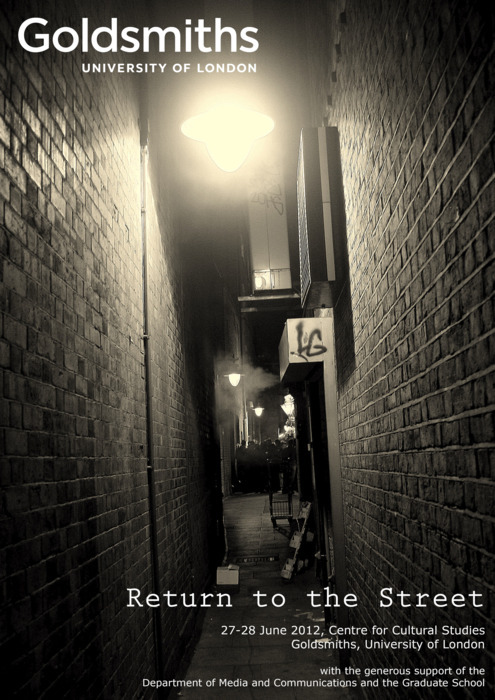
[Image - Return to the Street conference flyer via Limit Experience]
Identity formation and public debate do not simply occur online or through new media technologies. As the recent excessive imprisonment of those involved in the UK riots this summer demonstrated, the control and regulation of real bodies within real spaces is still very much at stake. Within the context of riots, protests and occupations in the UK and worldwide - the street appears to have become once more the space where people gather to be heard and counted. Considering this ‘return’ (although it is questionable whether we every really left the street) how might a line be drawn between the type of discourse which pays lip service to banal, neoliberal fetishised notions of street as site and object of subversive cool – incorporating graffiti, fashion, skateboarding, hiphop - and a more critical and engaged examination of processes of exclusion, confrontation and violence which constitute the everyday reality of life on and in the street. The street is and should not simply be flagged up as a site where power relations are toyed with as part of an ongoing Damien Hirst-meets-Banksyesque flirtation between public and private space. Such fetishisation ignores or glosses over notions of territory, surveillance and fear.
Yet at every moment attempts to challenge existing power structures from within the space of the street are at risk of being recuperated in the service of bourgeois, neoliberal modes of consumption. The return to pedestrianised zones in major European cities is frequently part of gentrification processes and occurs within privately owned spaces with the aim of encouraging consumerism rather than increased social interaction precluded by motorised city spaces. The festival atmosphere at protests and occupations might also be considered not simply as a means of creating greater solidarity amongst participants but as embodying a Bakhtinian form of carnival in which the political impetus of the event or movement exhausts itself in a media circus of spectacle and rhetoric staged between protestors and law-enforcement.
Despite the growing importance of social media in our everyday lives, our city streets are still indispensible sites for the exercise of citizenship. And yet a vibrant street culture, though laudable, will never be sufficient to guarantee our civil liberties against intended or accidental forces of societal control. No matter how subversive particular urban practices assume themselves to be, they are never wholly immune to recuperation or exhaustion by way of spectacle and consumption. One more effort is always required.
What is at stake for a critical urbanism is not EITHER street culture OR critique, but rather BOTH street culture AND critique. We must be able to think the complex interactions between graffiti and protest, fashion and territory, shopping and riots, skateboarding, surveillance and exclusion...No small task!
The full call for papers for the conference can be hound here.
Incidentally the conference coincides nicely with the London Festival of Architecture 2012 in which I'm hoping to participate. With the theme of 'The Playful City' the LFA2012 could easily descend into a nostalgic apology for the kind post-industrial, pre-crunch aspirations associated with Richard Florida's 'creative class' and the 'creative cities' in which urbanist Charles Landry supposed they would live.
Here's to those with a little more imagination who take up the critical urbanist challenge! Play hard!
Via Limit Experience

