Tuesday, 5 October 2010

Ballardian Architecture: Inner and Outer Space

Back in May the Royal Academy of Arts held a symposium entitled Ballardian Architecture: Inner and Outer Space. I was incredibly disappointed not to be able to attend so I was particularly pleased when, in addition to the mp3s available above, videos of the event were posted by static tv on behalf of The London Consortium.

As indicated by the title of the symposium, each of the lectures are broadly structured around the distinction between the inner and outer operative in the fiction of the late British writer J.G. Ballard. What many of these discussions emphasise in their exploration of Ballard's work is the permeability of those barriers and thresholds ordinarily supposed to mark that distinction in each of its many guises.

By way of example we might consider the violent short circuiting of the libidinal economy of the individual and functioning of the capitalist market economy affected by the penetration of the skin by twisted metal staged by the auto 'accident' in Crash.

Below I offer a selection of the lectures that I found most interesting.


In the first discussion philosopher John Gray draws on Ballard's interest in celebrity culture and surveillance to pose the question as to whether we can expect there to be genuinely public spaces anymore. Gray explores the implications for political economy by way of a comparison with Guy Debord's theorisation of the spectacle in his 1967 book Society of the Spectacle.


In this second lecture the Bartlett's Nic Clear delivers his paper 'J.G. Ballard is an Enemy of the Architectural Profession'. Developing themes explored earlier in the issue of Architectural Design that he guest edited back in 2009, the lecture is offered as an exploration of new modes of architectural representation that are intended, in this case via the writings of Ballard, to stage an encounter between the architectural discipline and its outside.

An earlier interview outlining the development of this project, and featuring videos produced by his students in the course of his Ballard inspired 2007-08 programme for the Bartlett's Unit 15, can be found on the Ballardian website here.


In David Cunningham's presentation he compares Ballard's writing on space and place with those of his friend Iain Sinclair and the Anglo-German writer W. G. Sebald. In doing so he argues that, contrary to the "hunger for memory and place" of Sinclair and Sebald's writings, Ballard's provide a "profoundly urban, no-turning-back aesthetic of futurism and rawness", embodied in the architecture of Brutalism and the new forms of social interaction it might seem to promote.


The end of session panel discussion above features Gray, Clear and Cunningham answering questions from the floor on the subjects of time, the uncanny, sentimentality and social networking.


Chris Hall was one of the first online writers to discuss Ballard's work in his essay 'Extreme Metaphor: A Crash Course In The Fiction Of JG Ballard'. In this discussion Hall uses a reading of 'The Terminal Beach' to explore Ballard's use of particular types of architectural structures as metaphors for those aspects of ourselves that we try to repress. In doing so he develops the psychogeographic themes in Ballard's writings hinted at in Cunningham's discussion.


The lecture by British photographer Dan Holdsworth departs from the format of critical appreciation established by the speakers above. Having participated in the Crash: Homage to JG Ballard exhibition at the Gagosian gallery the previous month, Holdsworth reads passages from Ballard's works that resonate with the sparse and sometimes inhuman images suggested he captures through long exposure photography.


The closing speech of the symposium was made by Ballard's long term partner Claire Walsh. Naturally this offers a fascinating glimpse into the authors private life and the more guarded facets of his character.

The full set of videos can be found on the static tv while recordings of the sessions are available on the Royal Academy of Arts site here.

Saturday, 18 September 2010

Urban Orienteer in the Anti Design Festival 2010

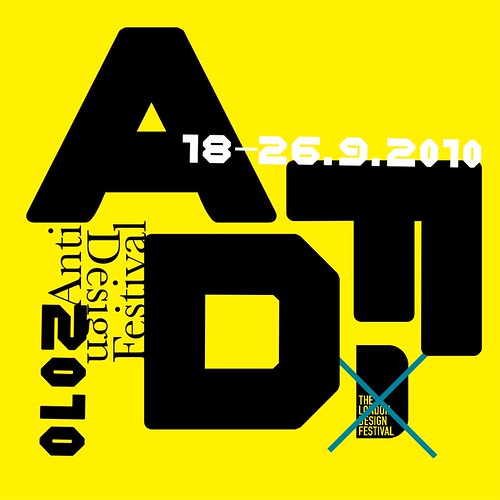
ADF Logo 7

Today sees the beginning of Neville Brody's Anti Design Festival which will include pieces from my ongoing collaboration with Mark at Dancing Eye. Entered as part of the festivals open submission programme these works should be found somewhere amongst the Front Space display in the gallery at 28 Redchurch Street in Shoreditch.

Intended as a response to "25 years of cultural deep freeze" the Anti Design Festival will run concurrently with the official city wide London Design Festival from the 18th to the 26th of September. Summing up in a brief interview on the Independent website Brody states:
The Government says if you're going to do anything – whether it's science or art – make sure you're making money from it.

What we're saying is that experimentation isn't there to make money; money is there to fund experimentation.
The Anti Design manifesto produced to accompany the event can be read here (with difficulty) or downloaded as a more palatable pdf.

As noted in the Creative Review, the event's self-professed 'outsider' status has been met with ambivalence by many commentators, and its 'anti-commercial', 'rebel' posturing has raised eyebrows in light of its sponsorship by the National Lottery. In order to make up your own mind I recommend checking out the debate hosted on the Guardian website between Brody and Ben Evans; director of the official festival.

A full programme for the Anti Design Festival can be found here (pdf).

Tuesday, 3 August 2010

RSA Animate - First as Tragedy, Then as Farce


Provocative as ever, in the most recent RSA Animate irrepressible Marxist philosopher Slavoj Zizek proposes that 'it is immoral to use private property in order to alleviate the horrible evils that result from the institution of private property'. The lesson he seeks to establish from this proposition is that the form of charity associated with corporate and social responsibility schemes such as Starbucks 'coffee ethics' is an essentially hypocritical and cynical gesture. What he terms 'capitalism with a human face' then remains complicit with the exploitation of the poor it is supposed to help, and all the more effective for the redemptive good conscience it leaves the consumer.

Personally I've always felt that there is something inherently wrong with the demonically perverse desire people harbour for a cup of Joe. I hate their smugness as they storm down the street brandishing their disposable cardboard and plastic cups, waving them aloft as if they were Prometheus bearing their torch for the people. FILTH! Basically makes me want to punch them in the face.

Spleen aside, the video above is an abridgement of the full lecture here, delivered on the release of his most recent book First as Tragedy, Then as Farce.

Monday, 2 August 2010

Urban Explorers: Quests for Myth, Mystery and Meaning


Those who attended our summer exhibition Transparency and the City: Public Spaces or Forgotten Places? will already have been introduced to the practice of urban exploration through the stunning photography of those participating the Urban Exploration // Behind the Scene installation. However, unless you attended the opening night you would not have seen the accompanying film Urban Explorers: Quests for Myth, Mystery and Meaning by Bradley at Place Hacking.

Including footage taken in the course of Bradley's own ethnographic research the film is comprised of a series of interviews with five scholars (Alastair Bonnett, Caitlin DeSilvey, Tim Edensor, Hayden Lorimer and David Pinder) whose work has engaged either with the practice of urban exploration directly, or with issues of urban decay, dereliction and exploration more generally.

It was my seeing an early edit of the film on Vimeo back in February that encouraged me to contact Bradley in the first place. Major props to Bradley for answering the email and agreeing to participate.

Update (05/10/2010) - A companion article for the above film has just been released in the journal Geography Compass (Volume 4, Issue 10, pages 1448–1461, October 2010). The article can now be read over on the Place Hacking website.

Monday, 26 July 2010

Transparency and the City Exhibition - Opening Night


The footage above is from the opening night of the recent exhibition Transparency and the City: Public Spaces or Forgotten Places? that I co-organised with Mark from Dancing Eye and the brilliant photographer Jon Spencer. This ran for two weeks from the 21st of June as part of the London Festival of Architecture 2010.

In the Shadows of the Crystal Palace

The image above is a photograph of the work Mark and I presented as part of our ongoing collaboration called In The Shadows of the Crystal Palace. Background information about the project can be found in an earlier post on this blog here.

Many thanks to Christina, Hwei Fan, Bradley and all of the Urban Exploration // Behind the Scene crew who accepted our invitations to participate.

Thanks also to all those who helped us organise the event or who attended. Finally, many thanks to Alan Baxter & Associates who hosted the event at their gallery in Farringdon.

Looking forward to seeing you all at the next one!

Friday, 2 July 2010

RSA Animate - Crises of Capitalism


In the video above Marxist geographer and urbanist David Harvey offers an overview of his recent research into the current economic crisis: The Enigma of Capital and the Crisis of Capital. Key for Harvey is the idea that 'capitalism never solves its crisis problems', rather 'it moves them around geographically'.

This excellent video is the most recent in a of a series produced by the RSA (Royal Society for the Encouragement of Arts, Manufactures and Commerce). Like the videos on TED these are designed to make new ideas and research accessible to the public. In the case of the RSA animations

Those interested in learning more about the Marxist ideas informing Harvey's analysis are encouraged to visit his website which includes a course of 13 video lectures on Marx's Capital: Volume 1.

The animation above is an abridged version of the full RSA hosted lecture which can be found here.

Thursday, 24 June 2010

Cities of Stories...now brought to life

In a previous post I suggested that the importance of narrative to our experience of the city demonstrates one of the very real ways in which the question of urbanism exceeds the planners concern over particular configurations of architectural and infrastructural elements, that might be assembled to form a cohesive whole. The good folks at Digital Urban are demonstrating this right now in the London Festival of Architecture with their project Tales of the City:
Via the project talesofthings.com we have been capturing people’s memories of objects and playing them back via small readable and writeable QR codes and RFID tags. Tales of the City extends the concept into the urban realm with the architecture of the city able to replay memories and its history.

The project will enable participants to add their own tales to buildings and view stories that other people have left.
All you need to get started is the free Tales of Things app for your iPhone or Android, and a quick look at the tutorial below:


While several sites across the city have been tagged since the beginning of the project in April, I understand that a trail of tags, beginning at St Leonard's Church in Shoreditch, has been set up especially for the festival. By following the tags from there you can participate in a personalised tour of the area to which you can add your own memories.

If you enjoy the Tales of Things app you may also wish to try the Museum of London's Street Museum app. This enables the user to see historic images of London from the Museum's archive superimposed on the present day location when viewed via your iPhone camera.

Many thanks to Digital Urban for kindly posting details of Urban Orienteer's own contribution to the festival.