Monday, 9 January 2012

Codified Space


Tonight filmmaker Justin Ascott's excellent short film Codified Space will be screened as part of The London Short Film Festival 2012. The screening will be in collaboration with Passenger Films Passenger Films who hold regular screenings related to the subject of cultural geography. In Ascott's film we see an unnerving study of a disused car park now transformed into an uncanny space:
Architecture is a system of signs that structure patterns of social use, but what happens when a building falls into disuse and no longer serves the function for which it was originally intended? Does it continue to transmit its own secret signals? The film metaphorically links eroded signs in a car park with distorted sonic signals - based on diegetic location sounds manipulated using modulation filters.
The screening is part of The Architecture of Re-Assurance programme hosted tonight by the Hackney Picturehouse from 6.15pm.

Other films being screened are as follows:

DRY by Nic Wassell.

A London-shot 16mm film about travel and memory, inspired by the Taiwanese films of Tsai Ming-liang.

THE FOLLY by Mira Aroyo.

The cottage home of an elderly lady who has to adapt to her remote surroundings as she gets older.

MIRAGE by Srdan Keca.

Dubai as an unfinished ‘post-apocalyptic’ city.

A THOUSAND TREES by Ed Lawrenson.

A Scottish new-town built for a non-existent population that never came.

The screenings will be followed by a panel discussion with the filmmakers and Justin Jaeckle, Curator of Public Programmes at the Architecture Foundation, hosted by Ben Campkin, Director of the UCL Urban Laboratory.

Monday 9th January 2012 at 6:15pm, Hackney Picturehouse (270 Mare Street London, E8 1HE, Tel: 0871 902 5734). £6, £5 conc, £4 Hackney Picturehouse members.

Via Passenger Films

Sunday, 8 January 2012

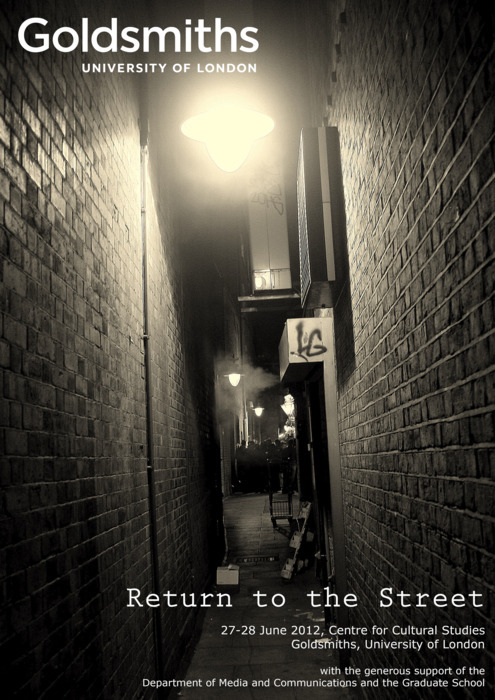
Return to the Street - Culture or Critique?


The Centre for Cultural Studies at Goldsmiths recently announced their two day Return to the Street conference running 27-28 June 2012. The call for papers provides an excellent statement of the socio-political landscape that a relevant and genuinely critical urban practice today would need to negotiate:
Identity formation and public debate do not simply occur online or through new media technologies. As the recent excessive imprisonment of those involved in the UK riots this summer demonstrated, the control and regulation of real bodies within real spaces is still very much at stake. Within the context of riots, protests and occupations in the UK and worldwide - the street appears to have become once more the space where people gather to be heard and counted. Considering this ‘return’ (although it is questionable whether we every really left the street) how might a line be drawn between the type of discourse which pays lip service to banal, neoliberal fetishised notions of street as site and object of subversive cool – incorporating graffiti, fashion, skateboarding, hiphop - and a more critical and engaged examination of processes of exclusion, confrontation and violence which constitute the everyday reality of life on and in the street. The street is and should not simply be flagged up as a site where power relations are toyed with as part of an ongoing Damien Hirst-meets-Banksyesque flirtation between public and private space. Such fetishisation ignores or glosses over notions of territory, surveillance and fear.

Yet at every moment attempts to challenge existing power structures from within the space of the street are at risk of being recuperated in the service of bourgeois, neoliberal modes of consumption. The return to pedestrianised zones in major European cities is frequently part of gentrification processes and occurs within privately owned spaces with the aim of encouraging consumerism rather than increased social interaction precluded by motorised city spaces. The festival atmosphere at protests and occupations might also be considered not simply as a means of creating greater solidarity amongst participants but as embodying a Bakhtinian form of carnival in which the political impetus of the event or movement exhausts itself in a media circus of spectacle and rhetoric staged between protestors and law-enforcement.

Despite the growing importance of social media in our everyday lives, our city streets are still indispensible sites for the exercise of citizenship. And yet a vibrant street culture, though laudable, will never be sufficient to guarantee our civil liberties against intended or accidental forces of societal control. No matter how subversive particular urban practices assume themselves to be, they are never wholly immune to recuperation or exhaustion by way of spectacle and consumption. One more effort is always required.

What is at stake for a critical urbanism is not EITHER street culture OR critique, but rather BOTH street culture AND critique. We must be able to think the complex interactions between graffiti and protest, fashion and territory, shopping and riots, skateboarding, surveillance and exclusion...No small task!

The full call for papers for the conference can be hound here.

Incidentally the conference coincides nicely with the London Festival of Architecture 2012 in which I'm hoping to participate. With the theme of 'The Playful City' the LFA2012 could easily descend into a nostalgic apology for the kind post-industrial, pre-crunch aspirations associated with Richard Florida's 'creative class' and the 'creative cities' in which urbanist Charles Landry supposed they would live. 

Here's to those with a little more imagination who take up the critical urbanist challenge! Play hard!

Via Limit Experience

Monday, 2 January 2012

New York Longboard


Yes I am obesessed! So here we are again with another great longboard video, this time by Alberto Alepuz of Perropro. This film sees longboarders Ra and Bruno Sorondo skate New York. Great opening sequence skating in the rain!

The Billsticker - Taking liberties with outmoded media

In the SENSEable and augmented cities of the near future it may be expected that traditional print media will become obselete. When your internet search history can be monitored remotely on the fly and appropriate adverts posted to you directly via your smartphone, why would anyone bother handing out paper flyers or posting them to the wall?

Something that has been interesting me recently is the way that old media are re-purposed as their prior uses are assumed by new media. If as Marshall McLuhan said "The medium is the message", could it be that traditional forms of print media such as the fly-post will communicate more fully on their own terms, unburdened of the uses to which they had previously been put? Perhaps, or perhaps not.  What we can expect that they will be used to carry different messages and find new audiences for those ready to exploit them imaginatively. Might we also find that they afford the willing unexpected liberties?

Here's a suggestive passage on 'The Billsticker' from Charles Manby Smith's Curiosities of London Life of 1853:
He may be said to live in the eye of the public as much, if not more, than any other man of his day; and is, whatever pretenders may choose to think, or cavillers to say to the contrary, essentially a public character. He is a literary man in a sense at once the most literal and extensive, and he caters for the major part of the population almost the only literature that they ever peruse. He is a publisher to boot, whose varied and voluminous works, unscathed by criticism, are read by all the world, and go through no end of editions. It is an axiom of somebody's - whose, we forget just now - that most men look at the world, and all things in it, through the medium of their own profession. If that be the case; how does the billsticker regard it? What tricks does his fancy play him? What are the myths ever revolving before his imagination? Is there a golden age looming in the distant future of his hopes? A good time coming, when every wall and hoarding, every house-front, window-shutter, and now interdicted inclosure - from the "palaces of crowned kings," down to the humblest "habitations of all things that dwell" - shall be patent to his paste-brush, open as charity to his broadsheet, and when he shall no longer be compelled to trudge beneath his heavy load in all weathers, through weary miles of mud and rain, in search of a sanctuary where the art and mystery of his calling is not forbidden?

[...] it may chance that an amateur billsticker may get himself into trouble, through ignorance of details with which the regular professional is intimately acquainted. Though the majority of hoardings - if bill-stickable at all - are free to all paste-pots, that is by no means the case with them all. Many which are of long standing are private property, and are let in compartments to the members of the profession, who of course tolerate no trespassers upon their domains, and would inflict the penalties of invasion upon any one caught in the act of violating their privileges. To such irregular aspirants to this honourable profession we commend the admonition, familiar to us on brick-walls and park-enclosures - STICK NO BILLS.
The text above can be found in full on Lee Jackson's excellent website Victorian London.

Further information about fly-posting and activism can be found on Urban75. Readers should be aware that fly-posting in the UK is covered by the Anti-social Behaviour Act  2003 and can incur fines of between £50 and £2500.

Thursday, 29 December 2011

Another awesome longboard video - Winter Night Longboard


Sooner or later I'll get bored of longboard videos...but not just yet. Here's another fantastic video by Spanish photographer and filmmaker Juan Rayos. Featuring Ra, Nacho, Quique, Kati, Paula, Borja, Luis, Jorge y Guido of the Madrid longboard scene Rayos' exquisite footage shows them skating with the city traffic one winter night earlier this year.

Pure asphalt poetry! Just watch it!

Tuesday, 13 December 2011

Angels Dancing on Concrete Waves


Watching Max Esposito's beautiful short film of longboarder Amanda Powell I couldn't help recalling feminist philosopher Luce Irigaray's passage on angels in her book An Ethics of Sexual Difference:
These swift angelic messengers, who transgress all enclosures in their speed, tell of the passage between the envelope of God and that of the world as micro- or macrocosm. They proclaim that such a journey can be made by the body of a man, and above all the body of a woman.
The stakes of Irigaray's angelology are the unexplored possibilities of relations between men and women, but also between women, each other and themselves. For Irigaray the figure of the angel stands as a mediator that speaks on behalf of desire, and particularly on behalf of a specifically feminine desire that has learned to speak on its own account without reliance on masculine categories. But where is the link between language, desire and skating?

Back in 2001 the popular image of skateboarding had become inextricably linked with the prankish machismo of Jackass and their copycats. In the same year architectural historian Ian Borden released his book Skateboarding, Space and the City: Architecture and the Body which celebrated the potential of street skating as a 'performative critique' of the city. In sympathy with the analysis of everyday life offered by Michel de Certeau, Borden was inclined to view the performance of the skateboarder as a series of enunciative acts. Like someone using and recombining the elements of their language different meanings, the skater chooses between different locations and architectural elements to include in their 'run'. Through this spatio-temporal editing the skater 'tactically' articulates a desire their own desire, while simultaneously usurping the spaces and times of the city maintained for other purposes. So what is that desire?

Both Irigaray and Certeau were psychoanalytically trained against the French Lacanian background in which the maxim is held that 'desire is the desire of the Other'. As the 'Other' is equated here with the impersonal law or culture of the male patriarchal order this would imply, for Irigaray in particular, that feminine desire will inevitably be alienated within or co-opted by a social order structured around masculine desire. While it is true that this structure is also replicated within skate culture itself, what struck me about Espisito's film was the way it depicted how much more skate has to offer both women and men.

Shortly after finding Espisito's film I came across another wonderful longboard video, featuring the Longboard Girls Crew of Madrid, and shot by Spanish photographer Juan Rayos:


With hands reaching out to each other, and dipping to the asphalt...
They speak like messengers, but gesture seems to be their "nature." Movement, posture, the coming-and-going between the two. They move-or stir up?-the paralysis or apatheia of the body, or the soul, or the world. They set trances or convulsions to music, or give them harmony.
Sometimes I imagine a sorority of angels, riding concrete waves, and dancing as they go.

Possessed to Skate!


Suicidal Tendencies takes me right back...but I have to admit that I preferred the faster version on Prime Cuts.

Let's Skate!